Luxury has become increasingly good at blurring the line between wanting something and feeling like we need it. The more we desire an object, the easier it becomes to mistake that desire for necessity. So perhaps it is no coincidence that beauty brands are beginning to sell cosmetics as something more than cosmetics.
Guerlain is one of the clearest examples.
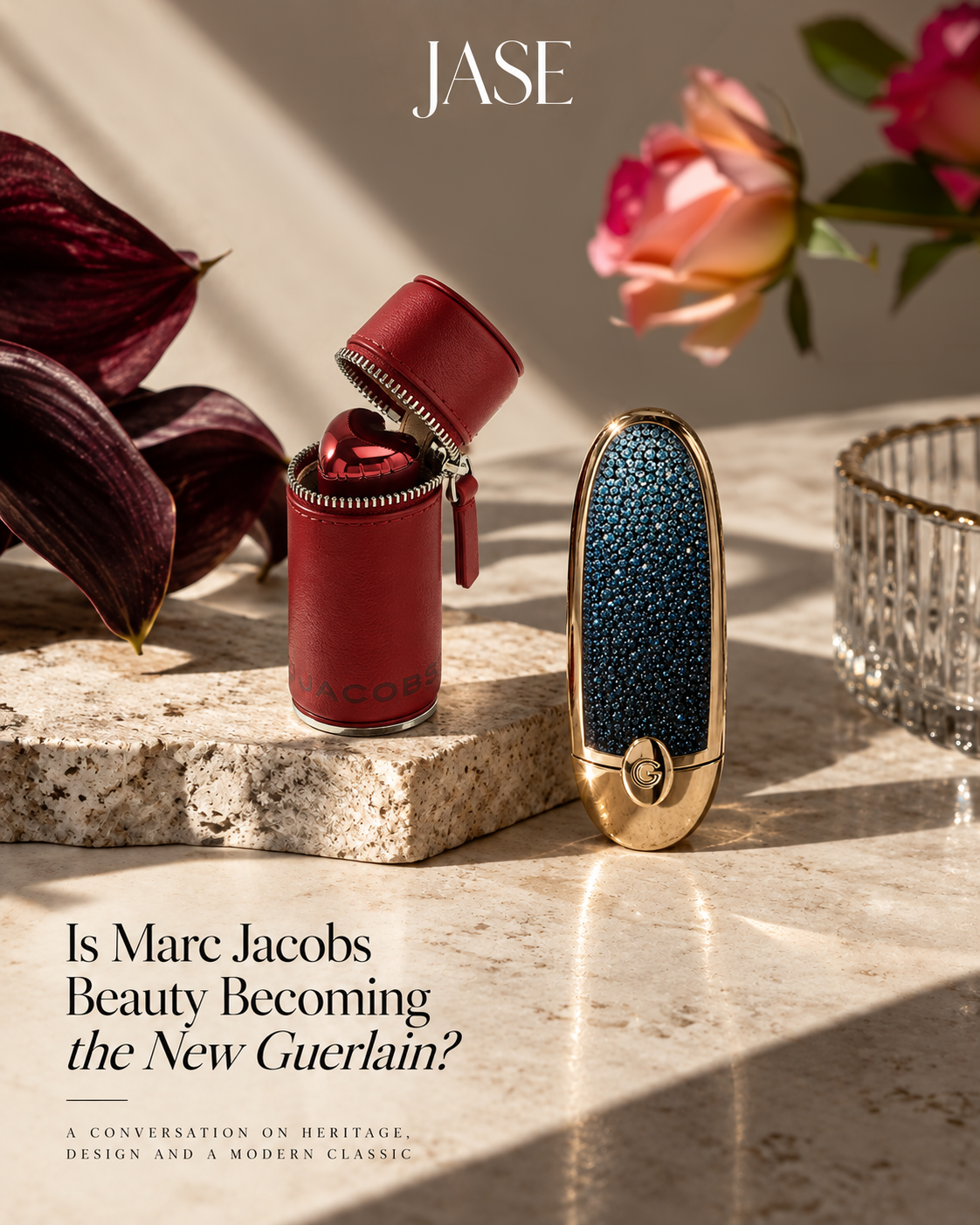
Rouge G is no longer simply a lipstick you throw into your bag. You choose the case, fall for the crystal-covered one, pick a colour, add your name. At some point, you begin to desire the object surrounding the product almost as much as the product itself.
And, admittedly, it works.
The crystal cases in particular are easy to see less as cosmetic packaging and more as miniature pieces of jewellery. Add personalisation to the equation, and the line between buying a Guerlain lipstick and owning a Guerlain object becomes increasingly difficult to define.
But this is where the system becomes more interesting.
Buying a single lipstick turns into a two-part experience of choosing a case and a refill. Once you choose one, you inevitably have to think about the other. What was once simply packaging becomes a desirable product in its own right.
Can we still call this just design? Or has design itself become part of the marketing?
Because what is being sold here is not simply prettier packaging. It is a small system of objects that complete one another — and one that can invite another purchase every time a new version appears.
Then Marc Jacobs enters the picture.
At first, the return of Marc Jacobs Beauty seems to lead us somewhere similar. There is a lipstick, there is a case, and once again there is a design intended to turn a cosmetic product into something more.
But Marc Jacobs takes the idea somewhere slightly different.
The lipstick case can be clipped onto a bag, taking lipstick out of the place where cosmetics usually live — hidden inside it — and turning it into something deliberately visible. More importantly, it places beauty directly inside the bag-and-charm universe Marc Jacobs already knows so well.
If Guerlain turns lipstick into a miniature piece of jewellery, Marc Jacobs brings it closer to a wearable fashion accessory.
And perhaps that is where the answer to the question “Is Marc Jacobs becoming the new Guerlain?” becomes clear.
Not really.
What is more interesting is that the industry itself is changing.
In luxury beauty, packaging is no longer simply the thing that contains the product. It is becoming a second product — something that can be collected, personalised, displayed and even worn. Brands are responding to the same desire, but translating it through their own visual language.
Guerlain does it through jewellery. Marc Jacobs does it through fashion accessories.
But there is another question for Guerlain.
For several seasons now, Rouge G cases have returned in different colours, finishes and crystal-covered variations. When they first transformed lipstick into a miniature jewel, the idea felt genuinely exciting.
Does it still feel quite as exciting now?
Or is an idea that once worked so well slowly beginning to repeat itself with every new iteration?
Perhaps this is exactly where Marc Jacobs has an advantage. It does not need to become the new Guerlain. Interpreting the same consumer desire through its own brand codes is already interesting enough.
Because the real competition in luxury beauty is no longer only about who makes the better lipstick.
It is about who can make us feel like we need one more.